The Pascagoula River · Pascagoula River
riverThe Singing River and the Pascagoula people
On still late-summer evenings, some say the lower Pascagoula hums like a swarm of bees. The story told to explain it is a legend of love, war and a people who chose the river.
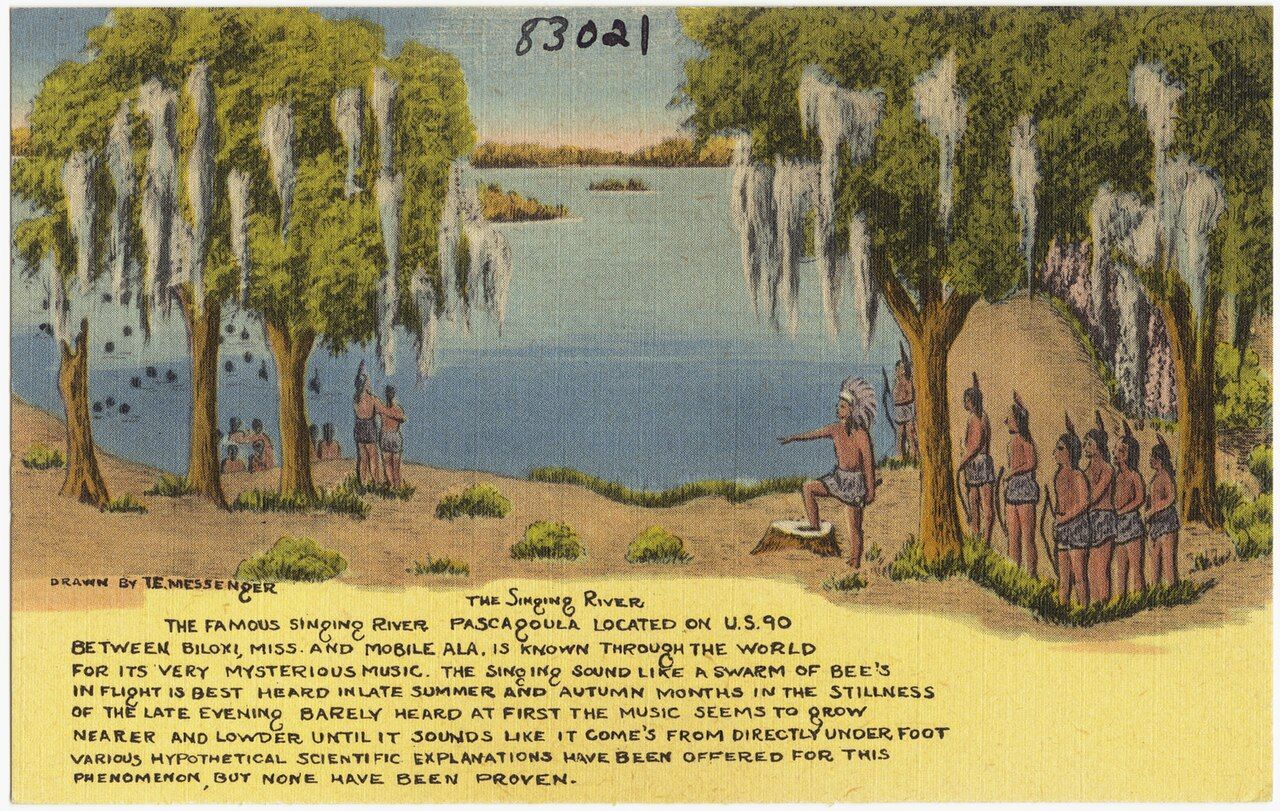
The Pascagoula River runs through the swamp and the marsh into the Mississippi Sound, and for a long time it has had a second name: the Singing River. People living along its lower reaches have described a faint humming sound rising from the water on still evenings, most often in late summer and autumn. It is said to start softly, then seem to grow louder and closer, as if it were coming from under your feet. Some describe it as a swarm of bees; others as a distant chord. Many people who live near the river have never heard it.
Explanations have been offered for years: fish, gas escaping from the sandy bottom, currents moving over sand, or a trick of sound carrying over water. None has been proven. What the river does have is a story, and the story has outlived every explanation.
The legend
The legend is told in many versions, and the names change from one telling to the next. In outline it goes like this.
The Pascagoula were a peaceful people who lived along the river. The Biloxi were their neighbors to the west. A young woman of the Biloxi, promised in marriage to a man of her own people, fell in love with a young chief of the Pascagoula and went to live with him. The Biloxi took this as an insult and made war on the Pascagoula.
The Pascagoula were few and the Biloxi many. Facing defeat and, in the story, death or slavery, the Pascagoula chose another way. Men, women and children joined hands and walked into the river together, singing a death song as the water closed over them. And so, the legend says, the river still sings with their voices.
It is important to understand this as a legend. It was written down by settlers and travelers, retold on postcards and in tourist guides, and shaped by the way outsiders liked to imagine Native people. There is no record that the Pascagoula as a people ended this way, and the story of their history is very different.
What is known of the Pascagoula and Biloxi
When French explorers arrived on the coast in 1699, they found several small Native nations living along the rivers and bays, among them the Pascagoula and the Biloxi. The Pascagoula lived along the river that carries their name; the name is usually translated as "bread people." The Biloxi lived around the bay and the lower rivers to the west, and their name is remembered in the city of Biloxi. The Biloxi spoke a Siouan language, related to languages spoken far to the north and west. Much less is known about the Pascagoula language.
Both peoples traded with the French and suffered from the diseases, wars and pressures that came with colonial rule. During the eighteenth century, as French, British and Spanish power shifted on the coast, both groups moved west into Louisiana. Their descendants joined other peoples there. The Biloxi are remembered today in the name of the Tunica-Biloxi Tribe of Louisiana, a federally recognised tribe. The Pascagoula merged with neighboring groups in Louisiana and Texas.
Further down the waterThe Pascagoula, a river left to runA story of the river
The legend says less about the Pascagoula people than about how later residents felt about the river. The lower Pascagoula is a place of dark water, cypress, tupelo and marsh grass, and it can be very quiet. On a still evening, with insects calling, frogs and fish moving and distant traffic carrying over the water, it is easy to see why people believed the river made music.
The name has spread far beyond the water. Businesses, a hospital and a mall on the coast have carried it, and the legend has been told in songs and stories. For many people in Jackson County, the Singing River is the name of home.
The river itself is worth knowing on its own terms. It is often described as the largest river system in the contiguous United States without a dam on its main stem, and its lower reaches are protected in large public lands. Our guide to the Pascagoula River covers the river from the forest to the sound, and our guide to the cypress swamps covers the swamp it runs through.
Listening for it
If you want to listen, go to the lower river on a calm evening in late summer or autumn, when the legend says the river is most likely to sing. Public riverbanks and launches around Pascagoula, Gautier and Moss Point give access to the water. Sit quietly as the light goes, away from the road if you can. You may hear something; you may hear only frogs and the wind in the marsh grass. Either way, it is a fine way to spend an evening.
Bring insect repellent, because dusk is mosquito time on the river. Watch your footing at the bank, and keep a good distance from alligators, which also like quiet evenings by the water. If you are on the river in a boat or kayak, carry a light and be off the water before full dark unless you know it well.
Telling the story with respect
The Singing River legend is part of the coast's culture, and it is a good story. It is also a story about real peoples whose descendants are alive today. When you tell it, tell it as a legend, and remember that the Pascagoula and Biloxi had their own history, languages and traditions, most of them lost to us now. The river keeps their names. That is the part of the story that is certainly true.